
Quick answer
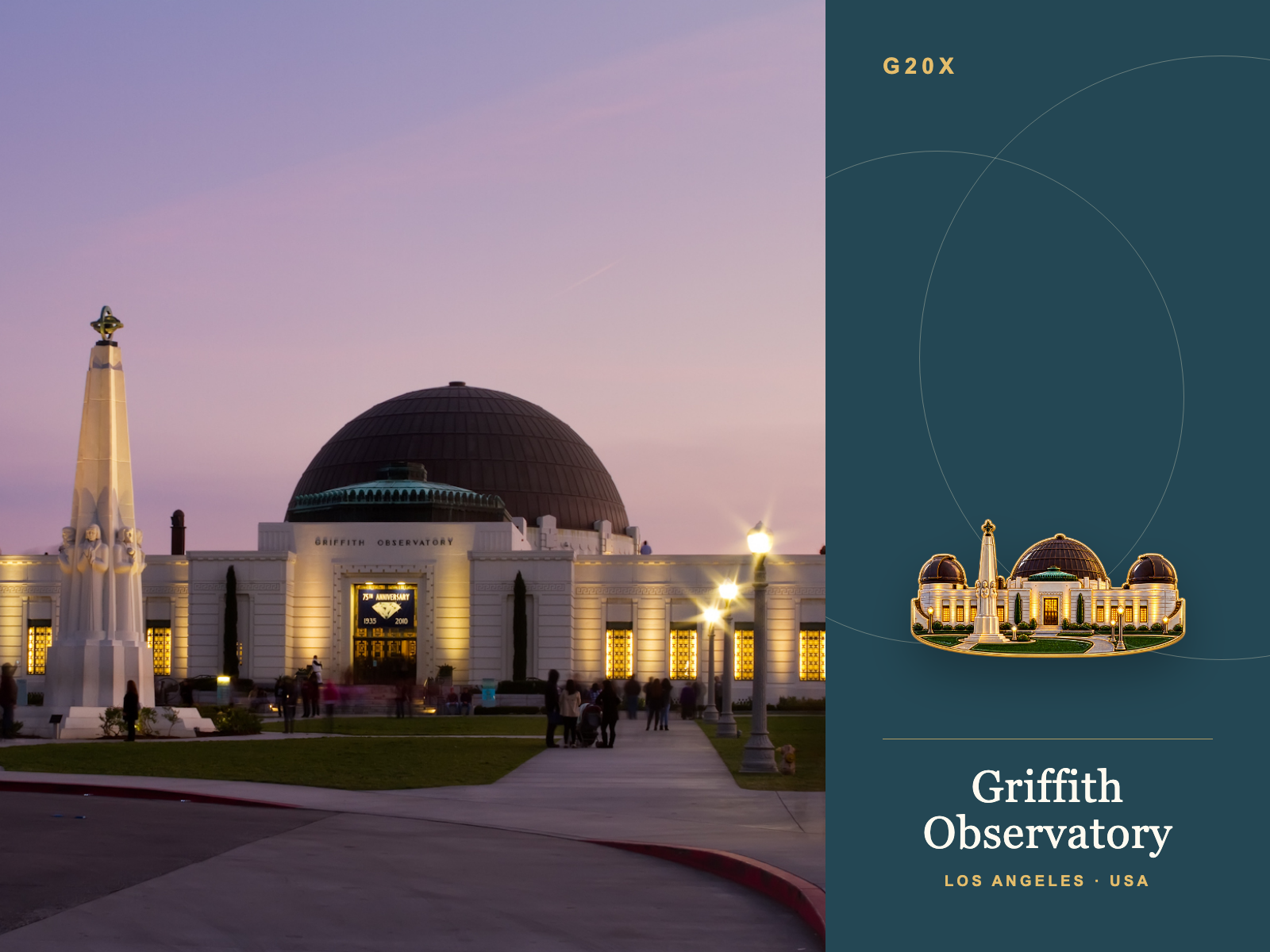
Griffith Observatory sits on Mount Hollywood in Los Angeles, where public astronomy began with a bequest from Griffith J. Griffith. Walk the terrace for city and ocean views, enter the rotunda for instruments and exhibits, then look for the Tesla coil and Astronomers Monument before watching the sky from the planetarium.
Full transcript
The Gift That Built the Observatory
Start on the south-facing slope of Mount Hollywood, where Griffith Observatory looks down over the Los Angeles Basin. The building is not just a dome on a hill; it is the physical answer to a promise made by Griffith J. Griffith, who wanted astronomy to belong to ordinary people. From the terrace, trace the city with your eyes: downtown to the southeast, Hollywood to the south, and the Pacific Ocean to the southwest. The Hollywood Sign is close enough to read its letters, while the basin spreads like a map below the ridge. The observatory opened in nineteen thirty-five, following Griffith's will, so the immediate thing to notice is how public this place feels. Stand at the railing, find the sign, and let the skyline settle into your eyes.
A Civic Face for the Sky
Walk toward the entrance and read the building as a blend of Greco-Roman symmetry and Art Deco restraint. Architects John C. Austin and Frederic M. Ashley gave the observatory a civic face, with a central rotunda that feels like a temple and detailing that belongs to nineteen thirties Los Angeles. Groundbreaking occurred on June twenty, nineteen thirty-three, and the formal dedication followed on May fourteen, nineteen thirty-five. Inside, the exhibits are not glass cases of distant science; they are hands-on arguments for looking up. Find the Tesla coil, where electricity makes a small storm in a room, then step outside to the Astronomers Monument. Stand near the rotunda, then look for the monument.
Shows, Films, and the Planetarium Dome
Finish at the planetarium, where the building's public mission becomes a show under the dome. The Samuel Oschin Planetarium has carried Los Angeles from local stargazing to space travel: in nineteen forty-eight, A Trip to the Moon premiered as the first planetarium show about space travel. Later, Apollo astronauts trained here to navigate by the stars between nineteen sixty-six and nineteen sixty-seven. The observatory also played itself in Rebel Without a Cause in nineteen fifty-five, which is why the terrace feels cinematic even on an ordinary afternoon. Before you leave, look for the Leonard Nimoy Event Horizon Theater, then step back to the terrace where the dome catches the last light. Find the planetarium entrance, look up at the dome, and save a seat for the sky.