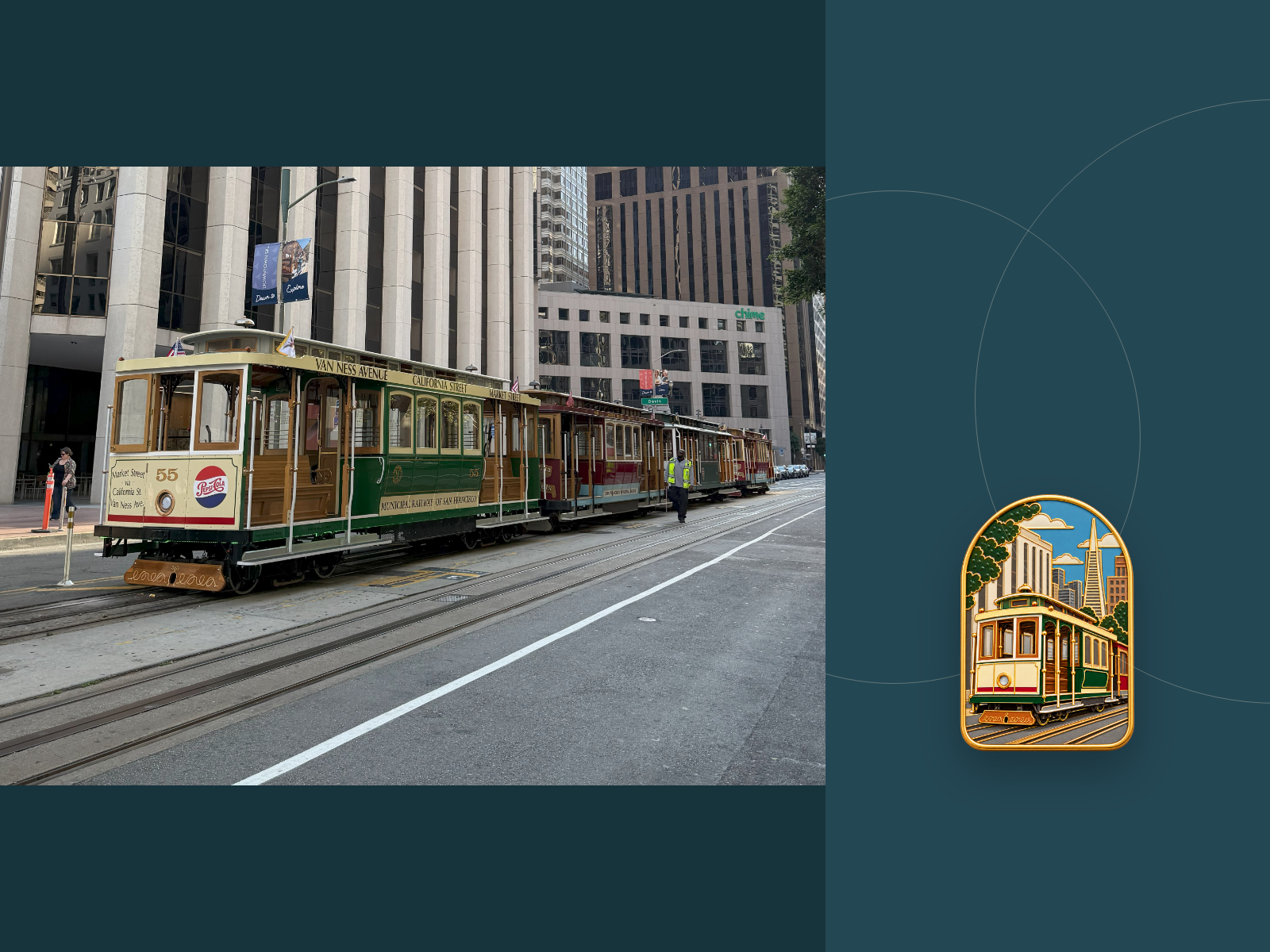
San Francisco Cable Cars collectible travel poster

Home / Destinations / San Francisco / San Francisco Cable Cars

Free audio guideSan Francisco2 min

San Francisco Cable Cars

The last manually operated cable car system on earth — and the four in the morning test run that made it possible.

2 min listen · free
2minute listen
6sources
3chapters
Freeto listen
San Francisco · 2 min listen · 6 sources

Quick answer

The San Francisco cable car system is the last manually operated one in the world. Cars carry no engine; a steel cable runs in a slot under the street at a constant 9.5 miles per hour, and the gripman closes a set of jaws onto it. Andrew Smith Hallidie tested the first line, the Clay Street Hill Railroad, at 4am on August 2, 1873.

1An 1895 retrospective records a single car run over the line at 4am on 1 August 1873
2Regular service on the Clay Street Hill Railroad began on 1 September 1873
3Each cable is 1.25 inches across and runs at a constant 9.5 miles per hour

Full transcript

1

Four in the Morning

On the first of August, 1873, at four o'clock in the morning, a Scottish-born engineer named Andrew Smith Hallidie stood at the top of Clay Street and prepared to test something nobody had built before. Hallidie made wire rope for the mines, and he had an idea: run that rope in a slot under the street, keep it moving, and let a car grip it to be pulled uphill. He raised the money largely from people who lived on Clay Street and wanted the hill solved. The test worked. Regular passenger service on the Clay Street Hill Railroad started on the first of September that year. The fare was five cents.

2

How It Actually Works

Here is the part that surprises people: the car has no engine. Under the street, a steel cable runs in a continuous loop at a constant nine and a half miles an hour, driven by a motor in the powerhouse at Washington and Mason. The operator — the gripman — pulls a lever that closes a set of jaws onto that moving cable, and the car is dragged along at exactly the cable speed. To stop, he releases the grip and works the brakes. There is no throttle. The car either has the cable or it does not. That is why San Francisco has the world's last manually operated cable car system. Everything depends on a person reading the hill and the traffic and deciding when to grip.

3

The Turntable

Twenty-three lines were built between 1873 and 1890. Three survive: Powell-Hyde, Powell-Mason, and California Street. The Powell cars have a grip at one end only, so they cannot simply reverse. At the end of the line they roll onto a wooden turntable and the crew pushes the car around by hand — the same solution used in the nineteenth century, still done by muscle today. The turntable at Powell and Market is the busiest, and the queue there can run long. If you would rather skip the wait, walk a block or two up the line and board at a regular stop. Hold the pole, keep your arms inside, and lean into the hill.

The checkable facts

  • An 1895 retrospective records a single car run over the line at 4am on 1 August 1873
  • Regular service on the Clay Street Hill Railroad began on 1 September 1873
  • Each cable is 1.25 inches across and runs at a constant 9.5 miles per hour
  • The powerhouse and car barn are at Washington and Mason Streets
  • Of the 23 cable car lines built between 1873 and 1890, three remain
  • It is the world's last manually operated cable car system
  • The fare was five cents.
  • Before 1906 the network covered roughly 53 miles of track and reached the Presidio, Golden Gate Park, the Castro and the Mission.
  • In 1947 city leadership proposed replacing them with buses.
Open in maps
Opens a search for this place — no app install, no account.

After the guide

Practical bookings for this stop. These are affiliate links: they cost you nothing extra and they do not change what we recommend.

Data that works on landing

Get a local eSIM →

Backup eSIM option

Compare eSIM plans →

Museum and attraction tickets

Book timed-entry tickets →

Multi-attraction city pass

Compare attraction passes →

Frequently asked

Who invented the San Francisco cable car?
Andrew Smith Hallidie, a Scottish-born manufacturer of wire rope for the gold and silver mines. He patented a grip that could clamp a rigid jaw onto a moving underground cable, then raised most of the construction money from residents of the hill he wanted to solve. He was a rope engineer, not a transit man.
How fast does a San Francisco cable car travel?
Nine and a half miles an hour, and nothing else. The underground cable runs at that single speed, so a car that has gripped it matches the cable exactly, with no accelerator and no gearbox. The only variation comes downhill, when the gripman lets go and controls the descent on the brakes alone.
How many cable car lines are left in San Francisco?
Three. Before 1906 the network covered roughly 53 miles of track and reached the Presidio, Golden Gate Park, the Castro and the Mission. Electric streetcars were cheaper to run and replaced most of it. What remains is the steepest fraction of the original system, and it is a National Historic Landmark.
Why were the cable cars never scrapped?
In 1947 city leadership proposed replacing them with buses. Friedel Klussmann organized the Citizens' Committee to Save the Cable Cars, took the question to the ballot, and won in a landslide. Minimum service levels for the lines are now written into the San Francisco city charter, so removing them takes a vote rather than a memo.
Where can you see the machinery that pulls the cars?
At the powerhouse on Mason Street, which doubles as the Cable Car Museum. A viewing gallery looks down on the great winding wheels that keep the cables moving under the streets, and the noise explains the system better than any diagram. The last surviving grip car from the 1873 Clay Street line, car number 8, sits in the same building.

This guide costs nothing

Every standard guide plays end to end, with no signup and no card.

Image credit

Photo: San Francisco (California, USA), Cable Car -- 2012 -- 4180.jpg by Dietmar Rabich, via Wikimedia Commons, licensed under CC BY-SA 4.0. This poster is a derivative work and carries the same licence.