
Quick answer
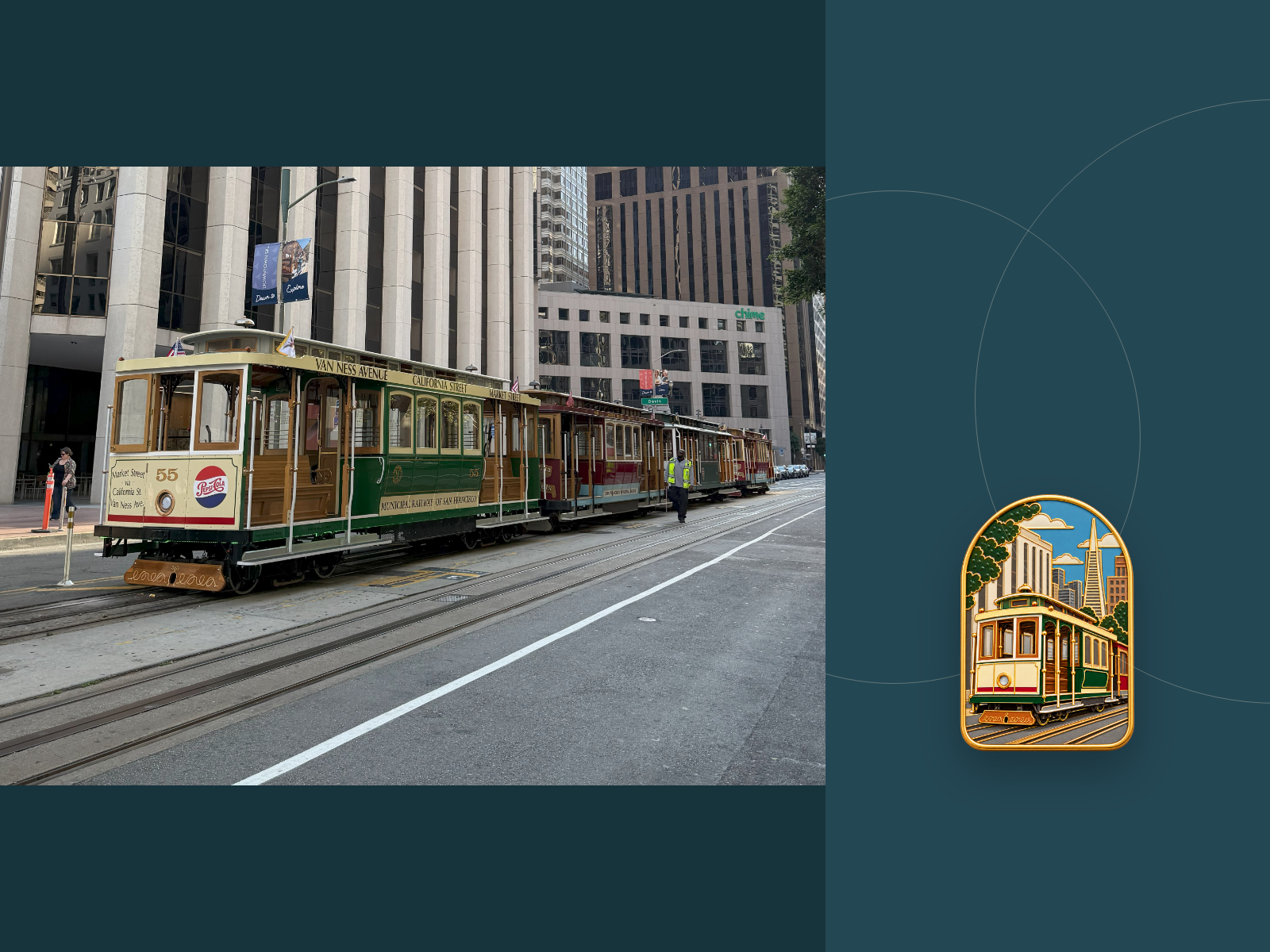
The San Francisco cable car system is the last manually operated one in the world. Cars carry no engine; a steel cable runs in a slot under the street at a constant 9.5 miles per hour, and the gripman closes a set of jaws onto it. Andrew Smith Hallidie tested the first line, the Clay Street Hill Railroad, at 4am on August 2, 1873.
Full transcript
Four in the Morning
On the first of August, 1873, at four o'clock in the morning, a Scottish-born engineer named Andrew Smith Hallidie stood at the top of Clay Street and prepared to test something nobody had built before. Hallidie made wire rope for the mines, and he had an idea: run that rope in a slot under the street, keep it moving, and let a car grip it to be pulled uphill. He raised the money largely from people who lived on Clay Street and wanted the hill solved. The test worked. Regular passenger service on the Clay Street Hill Railroad started on the first of September that year. The fare was five cents.
How It Actually Works
Here is the part that surprises people: the car has no engine. Under the street, a steel cable runs in a continuous loop at a constant nine and a half miles an hour, driven by a motor in the powerhouse at Washington and Mason. The operator — the gripman — pulls a lever that closes a set of jaws onto that moving cable, and the car is dragged along at exactly the cable speed. To stop, he releases the grip and works the brakes. There is no throttle. The car either has the cable or it does not. That is why San Francisco has the world's last manually operated cable car system. Everything depends on a person reading the hill and the traffic and deciding when to grip.
The Turntable
Twenty-three lines were built between 1873 and 1890. Three survive: Powell-Hyde, Powell-Mason, and California Street. The Powell cars have a grip at one end only, so they cannot simply reverse. At the end of the line they roll onto a wooden turntable and the crew pushes the car around by hand — the same solution used in the nineteenth century, still done by muscle today. The turntable at Powell and Market is the busiest, and the queue there can run long. If you would rather skip the wait, walk a block or two up the line and board at a regular stop. Hold the pole, keep your arms inside, and lean into the hill.

_(7779211446).jpg)
.jpg)
_VIEW_OF_CLAY_STREET_SHOWING_THE_WIRE_RAILROAD_pg191.jpg)
.jpg)

_(14779177323).jpg)




.jpg)
