
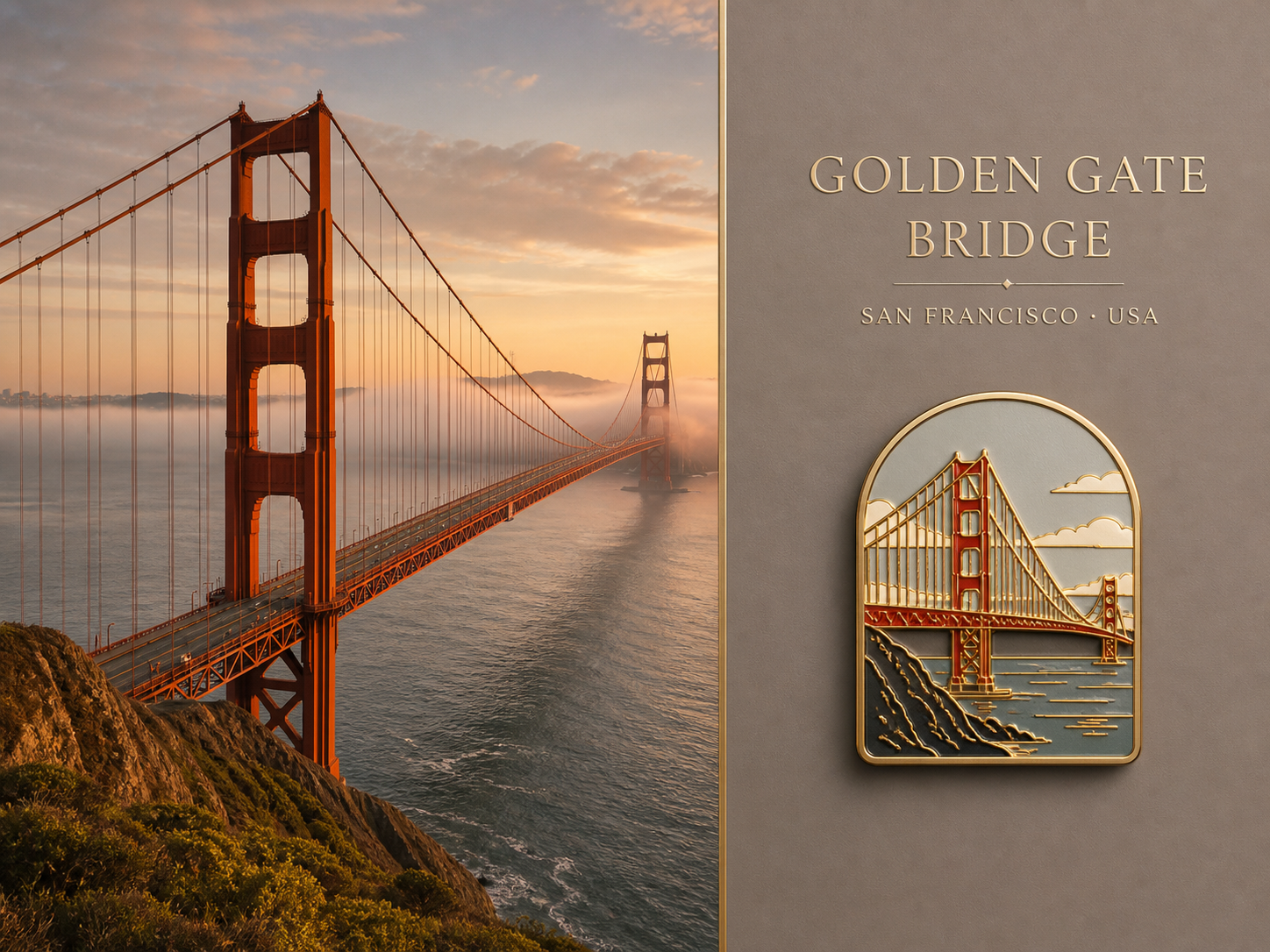
Golden Gate Bridge Walk collectible travel poster

Home / Destinations / San Francisco / Golden Gate Bridge Walk

Free audio guideSan Francisco2 min

Golden Gate Bridge Walk

Walk a bridge engineers said could not be built — and it was never red.

2 min listen · free
2minute listen
6sources
3chapters
Freeto listen
San Francisco · 2 min listen · 6 sources

Quick answer

The Golden Gate Bridge color is called International Orange, and the span has never been red. The shade arrived as the primer coat on steel shipped from the East Coast, and consulting architect Irving Morrow argued to keep it because it stands out against fog and water. The 4,200-foot main span opened on May 28, 1937 and held the world record for 27 years.

1The main suspension span is 4,200 feet and was the longest in the world from 1937
2Construction began in 1933 under chief engineer Joseph Strauss; the bridge opened in 1937
3There are approximately 600,000 rivets in each tower

Full transcript

1

The Bridge That Couldn't Be Built

Engineers said it couldn't be done: a 4,200-foot suspension span across a mile-wide strait with riptides, deep water, and fog that would stop any construction. But in 1933, chief engineer Joseph Strauss broke ground anyway. The Golden Gate Bridge was built in just four years, and when it opened in 1937 it was the longest suspension bridge in the world — a title it held for 27 years. The name was never the bridge's own: the Golden Gate is the strait underneath it, the entrance to San Francisco Bay, and it was called that long before anyone thought a span could cross it.

2

International Orange

The bridge's famous color isn't red — it's called International Orange, a shade chosen for two reasons: it stands out beautifully against fog and water, and it was already used in the steel primer, saving money. You will be told the bridge is repainted end to end every year, or every seven. It is not, and the District says so plainly: painters work continuously but by priority, on whatever the inspectors rank as worst. The colour was an accident kept on purpose — the steel arrived in a reddish primer, and consulting architect Irving Morrow argued for leaving it that way instead of the grey, or the black and yellow stripes, that were on the table. There are about 600,000 rivets in each tower and 80,000 miles of wire in the two main cables. On foggy days, the towers seem to float above the clouds; locals say you haven't seen the bridge until you've seen it disappear.

3

How to Walk It

Pedestrians use the east sidewalk, and it runs on gates rather than on daylight — it opens early and shuts well before midnight, earlier in winter. Enter from the southeast parking lot near the visitor center, or from the bridge pavilion, and check the posted hours before you set off. The full crossing is 1.7 miles each way. Go to Battery Spencer on the Marin side for the postcard shot, or walk down to Fort Point underneath for the better one.

The checkable facts

  • The main suspension span is 4,200 feet and was the longest in the world from 1937
  • Construction began in 1933 under chief engineer Joseph Strauss; the bridge opened in 1937
  • There are approximately 600,000 rivets in each tower
  • The bridge is painted continuously by priority, not end to end on a cycle
  • International Orange came from the primer on the delivered steel, which consulting architect Irving Morrow wanted kept
  • The east sidewalk opens to pedestrians at 5am, closing at 9pm in daylight saving time and 6:30pm from November to March
  • The bridge is 1.7 miles long
  • The Golden Gate Bridge was built in just four years, and when it opened in 1937 it was the longest suspension bridge in the world — a title it held for 27 years.
  • There are about 600,000 rivets in each tower and 80,000 miles of wire in the two main cables.
  • The span measures 1.7 miles end to end, so a one-way crossing takes most people thirty to forty-five minutes, and about ninety minutes round trip with stops.
  • Work ran from January 5, 1933 to the opening on May 28, 1937, about 1,604 days.
  • Eleven workers still died, ten of them when a platform tore through the net.
Open in maps
Opens a search for this place — no app install, no account.

After the guide

Practical bookings for this stop. These are affiliate links: they cost you nothing extra and they do not change what we recommend.

Data that works on landing

Get a local eSIM →

Backup eSIM option

Compare eSIM plans →

Museum and attraction tickets

Book timed-entry tickets →

Multi-attraction city pass

Compare attraction passes →

Frequently asked

What color is the bridge, exactly?
International Orange, a vermilion-leaning shade that reads warmer than red. It arrived by accident: the steel shipped from the East Coast wore an orange-red lead primer, and consulting architect Irving Morrow pushed to keep that tone instead of the grey the district expected or the black-and-yellow stripes the Navy wanted for visibility.
How long does it take to walk across?
The span measures 1.7 miles end to end, so a one-way crossing takes most people thirty to forty-five minutes, and about ninety minutes round trip with stops. The east sidewalk is the pedestrian side. Wind across the exposed middle third is usually stronger and colder than anyone expects, whatever the temperature onshore.
How was it built so quickly?
Work ran from January 5, 1933 to the opening on May 28, 1937, about 1,604 days. Strauss insisted on hard hats and strung a safety net beneath the deck, which caught nineteen men who called themselves the Halfway-to-Hell Club. Eleven workers still died, ten of them when a platform tore through the net.
Where do you get the classic photograph?
Battery Spencer, on the Marin side above the north tower, gives the head-on shot with the city behind it. Fort Point sits directly beneath the south end for the arch-and-waves angle. Crissy Field and Baker Beach give the long profile. In summer the fog usually clears in the afternoon, not the morning.

This guide costs nothing

Every standard guide plays end to end, with no signup and no card.

Image credit

Photo: The Bridge (August 2013).jpg by Frank Schulenburg, via Wikimedia Commons, licensed under CC BY-SA 3.0. This poster is a derivative work and carries the same licence.